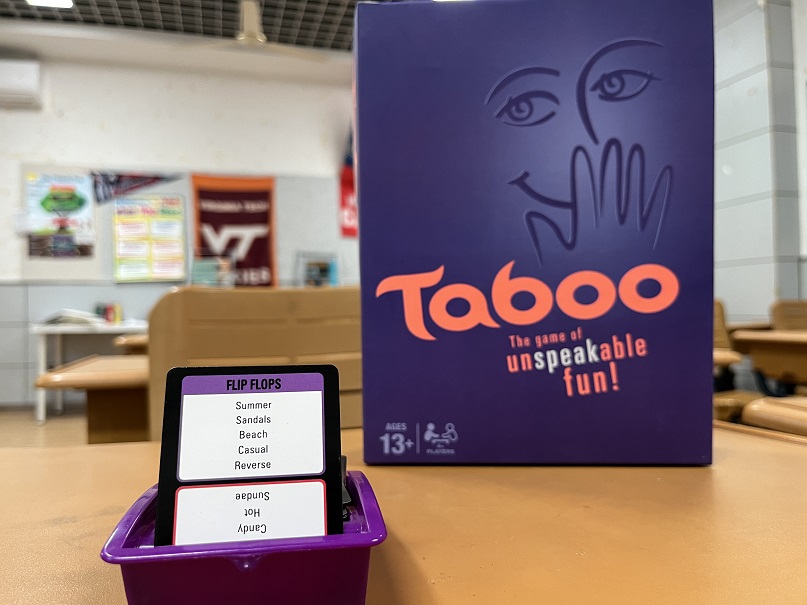
Speaking tasks are important for language learners. Speaking puts students on the spot and forces them to be quick and use their language in real time. This is difficult and might not be the best measure of a student’s ability, but speaking is fundamental to communication, so all language courses incorporate these activities. One of the biggest hang-ups for my students is forgetting a particular word and completely derailing their practice. I’d been trying strategies to help them talk around words they don’t know when I stumbled on Taboo. So far it has been a hit; the students like it and they are being more descriptive during their speaking practice.
Taboo is a vocabulary game. Each player gets a card with six words. The first word is highlighted in a color and the remaining five are on a white background. The cardholder needs to describe the highlighted word without using any of the five other words on the card, hence the talk around practice.
Students sometimes have problems because the one guessing doesn’t know the vocabulary word in the target language. No amount of description will allow a student to guess “defrost” if they’ve never heard the word before. I allow students to answer in their home language (provided the other student speaks the same language) and record the new vocabulary in their notebooks.
Taboo comes in many languages, but the English version is the most common. Teachers of other languages could still use an English version and ask students to translate the vocabulary on the cards as an assignment before playing. High-level students might even be able to translate the cards as they play, adding an additional challenge to the speaking task. Much like Codenames, Taboo works well for teachers on a budget. The game contains hundreds of cards, and each card has four words to guess. Students only need a few cards to work in pairs or small groups. One copy ought to be enough for almost any classroom. Taboo is cheap and easily found online for your language learning nee

 The Keasy Depot