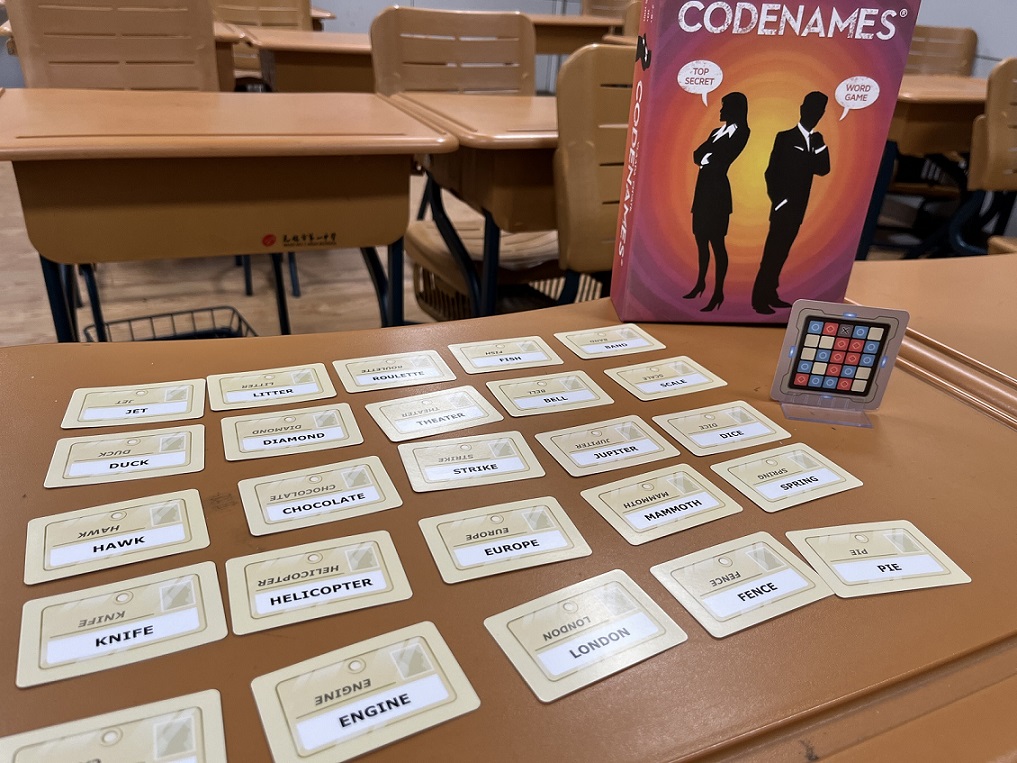
Codenames, designed by Vlaada Chvátil and published by Czech Games Edition, is one of the highest-ranked party games on BoardGameGeek. I think it is easier to adapt good games to a classroom than try to convince students edutainment games are good. When I use a game for class, I want the students to have fun while learning. Codenames is a great language class game because it is so easy to modify for classroom needs.
Codenames is a team-based word game. Each team has one spymaster and a few agents. The spymasters know the locations of their spies, and the agents are attempting to make contact with the words representing codenames. The spymasters give their team a one word clue and a number, for example, “food: 2.” This means that two spies are represented by two cards relating to food, “ice cream” and “honey.” The agents decide which cards to reveal. They might contact their spies, the opposing team’s spies, innocent bystanders, or the assassin which causes the revealing team to instantly lose. The teams alternate turns until one team wins by contacting all their spies. The rules are super simple. It only takes five minutes to explain, and once my teenage students get through a game (approximately twenty minutes) they have little trouble grasping the strategy.
When I explain the game to my students, I strip away the theme and focus on the words in order to keep it simple. I like teams of three one spymaster and two agents, but any size is possible. Since students will play as a team, larger groups are less effective because there will be fewer opportunities for each player to participate.
Luckily, the components of Codenames make it very easy to increase the number of teams. The base box contains 200 double-sided word cards and 40 location key cards. A single game only requires 25 word cards and 1 key card. The game provides nice character cards, but not enough for a classroom running multiple games. The easiest solution is to cut extra cards with blue, red, white, and black paper. An A4 sheet folded and cut into 16 squares provides perfectly sized cards. Each game of two teams will need 9 red cards, 9 blue cards, 7 white cards, and 1 black card. The provided word cards allow for up to 8 games to be played at once.
Codenames is cheap, often $15-20 at retail. This fact, plus the simple rules and easy scaling, make Codenames an excellent starting place for language teachers who want to begin incorporating board games into their lessons.

 The Keasy Depot
1 Comment