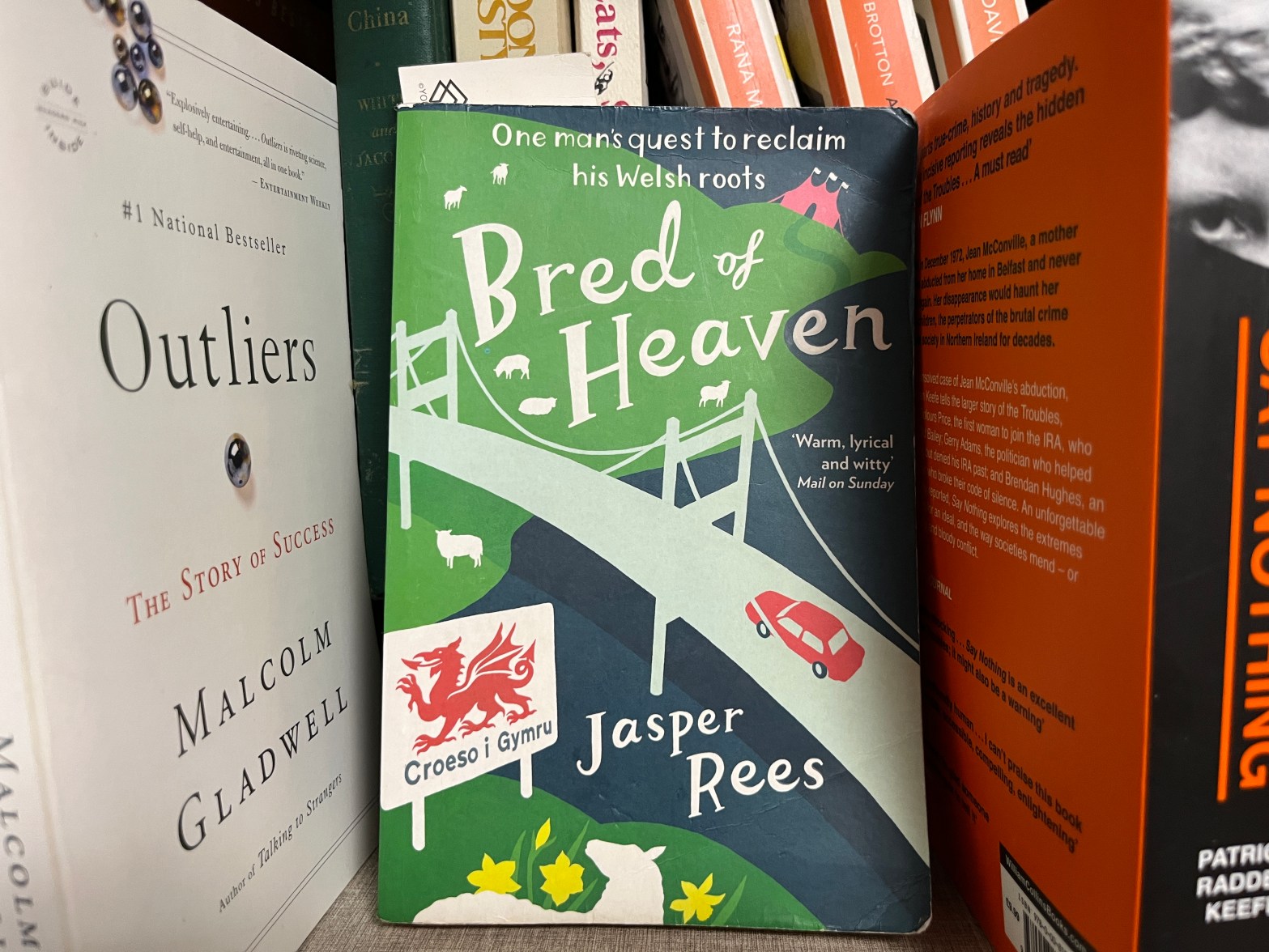
I’ve developed a serious crush on Wales. It all began when I started reading Bred of Heaven by Jasper Rees. Before that, I rarely thought of Wales. I have no history with Wales. I’ve never been and I doubt I’ll ever visit. But somehow Rees has tugged my heart enough for me to start learning Welsh on Duolingo, I am especially enjoying the rhyme of of dw i’n hoffi coffi – I like coffee. I listen to Stori Tic Toc from BBC Cymru and get excited when I recognize a single word in the avalanche of sound. I want to watch Welcome to Wrexham because I like Rob McElenney and apparently Wales as well. Rees’ personal journey to rediscover his Welshness in Bred of Heaven is touching and funny and charming all rolled into an easy-to-read travelogue.
I started Duolingo’s Wales course about a third of the way through the book. Rees makes it a point to learn Welsh as an adult and sprinkles the book with Welsh words and phrases. Of course he translates the phrases for his audience, but I wanted to know how these words were pronounced. And much like Stori Tic Toc, I get a fun dopamine hit when I catch the meaning of a Welsh phrase Rees uses before he translate it. It is only a single word word but I was excited when I read, “Dim gem! Eira!” and I knew Rees’ planned rugby game was canceled. I almost gasped at myself when I read Clyb Rygbi Cymru Caerdydd, remembered that dd in Welsh is a th sound and realized Caerdydd was Cardiff.
The Welsh language is a central pillar to Rees’s “quest to reclaim his Welsh roots.” It is fitting that the chapter Siarad = Speak is amazing. Rees does an excellent job capturing the whiplash highs and lows of an adult language learner. Some days we feel like we’re killing it, and some days we feel like we’re getting killed. These experiences are coupled with Rees’s concern and self-doubt of his learning abilities. There’s no reason for him to learn Welsh other than some abstract internal goal he has set for himself. It would be much easier to bail and focus all his attention on something more tangibly useful. Rees concludes the chapter with one of the best descriptions of why we do “useless” things. I got a little misty-eyed on the subway reading him describe a final dinner with his classmates at the Welsh Language and Heritage Center.
“But reason not the need. Why else are we gathered here this evening round this table? We have stumped up our money and time, volunteered a diminishing stock of middle-aged brain cells to staff the barricades and in our small grammatically challenged way helped stem the predatory forces of English, which has the might of history behind it. We have gone out to bat for this older purer language to which we all feel an ever-deepening allegiance. As do thousands of others. It’s an epiphany: a moment when suddenly everything is utterly clear. None of them notices the embarrassing detail of my eyes filling as I formulate my conclusion.”
Bred of Heaven will almost certainly not spur in you an unexplained and unrequited infatuation with Wales. I have no idea why it did in me or how long Wales will hold my affection. In all truth, I’ve only read half the book. I am taking slow and savoring the experience. Part of me dreads finishing it. If you have ever wanted to learn more about Wales and what it means to be Welsh in the twenty-first century, Jasper Rees is a top-notch tour guide.

 The Keasy Depot