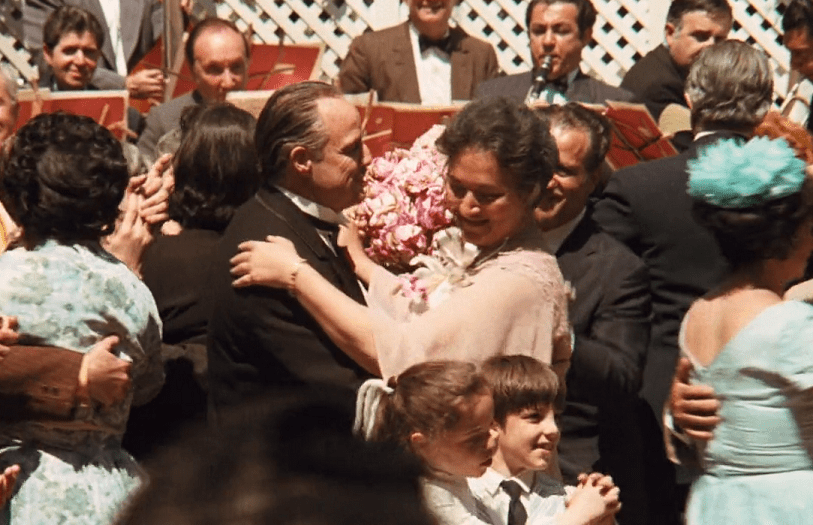
If I had a nickle for each 1970s Best Picture winner that began with an long wedding scene I’d have two nickles, which isn’t a lot but is strange it has happened twice. It might happen more, I haven’t seen all the winners yet. The Godfather and The Deer Hunter are both full of machismo and hyper-masculinity, not where one would expect to spend upwards of an hour of The Deer Hunter watching people eat and dance. It seems weird that weddings would be such a thing in these films. When people think of The Godfather they think of making offers that can’t be refused and The Deer Hunter brings up Russian roulette even though, let me stress it again, almost a full third of the three hour film is a wedding. Why are these scenes so long? I have three theories: the Cazale connection, money, and story-telling.
I’ll quickly mention the hopefully obviously facetious Cazale connection because I want to talk about John Cazale. He must have had some sort of aura that brought out the absolute best in film-making. When it comes to Best Picture nominations, he’s batting a thousand. He was in five films over his career and each earned a nomination. Three of the five won. That’s obscene. So my crackpot theory is that the powers that be wanted Cazale on The Deer Hunter but he knew his totemic powers and demanded they film a long wedding scene like in The Godfather, his first role. It almost makes sense, Cazale had terminal cancer and wanted a bigger and better wedding scene to bookend his film career. The real life facts are completely different and much sadder, but also touching how Robert De Niro and Meryl Streep rallied for him.
On to money. This is theory is more plausible than the Cazale connection but may be completely wrong. I don’t know anything how films are financed and what things cost. But my idea is that both of these movies wanted to be big sweeping epics. Every epic needs some sort of massive and flashy scene. In today’s Hollywood this is accomplished with CGI. In the 80s and 90s, practical effects were cranked up to eleven. There were practical effects in the 1970s, but I would guess a big scene full of effects costs a lot more than hiring a bunch of extras and putting them into wedding wear. Hire a wedding band and a catering company to provide giant spreads of foods. Big weddings in real life are events. A director without access to CGI or practical effects but still wants a big scene can do a lot worse than an intensive wedding scene. And like most things in life, there are fixed costs to a scene. The longer the scene’s run time, the more palatable those fixed costs become.
Finally there is a story-telling use for both these wedding scenes. This is probably the most realistic reason. Both wedding scenes are used to introduce the large cast of characters. In The Godfather, Kay is an audience surrogate. Michael spends much of the scene describing the different people to Kay giving the audience a list of dramatis personae. Show don’t tell is the rule, but there are so many characters in The Godfather that telling is almost necessary. Kay provides a plot-appropriate reason for this simple telling. The Deer Hunter has fewer characters and as such sticks with showing instead of telling. The hour of partying is full of longing glances, drunken arguments, romance, mischief, and all the other natural human behavior of a wedding. At the end of the wedding the viewer knows all about the characterizations and motivations of everyone in the movie. Some people think these scenes are too long. I disagree. I think what they are doing needs the time. And the scenes are fun. The dance with Christopher Walken, John Savage,and Streep was excellent. Never underestimate the spectacle of a well-choreographed, energetic dance number with dozens of extras.
All in all, the wedding scenes in The Godfather and The Deer Hunter are amazing. The argument could be made that they are somewhat superfluous to the plot and could be trimmed. I don’t agree with that argument but I’ll listen to it. I enjoy the scenes and I think more movies should be daring enough to, again let me stress this, spend an entire third of the movie barely moving the plot. It’s a bold move that I appreciate.

 The Keasy Depot