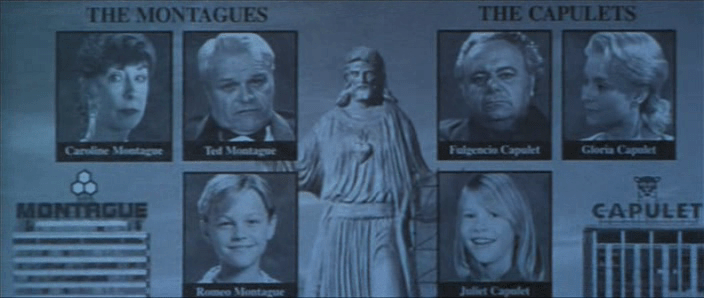
Another school year has finished and as always, we watched the 1996 Romeo and Juliet in my English classes because I love that movie so much. We either study the play in class and watch the film as an example of creative reinterpretation, or we watch it as an end-of-year treat if Romeo and Juliet was not part of the year’s syllabus. Either way, I am sure I have seen the movie more than almost every person on the planet. I love it anew every time.
One reason I think it is so great is the film’s focus on the world of Verona and the people surrounding the titular characters. Everyone knows Romeo and Juliet as two tragic lovers and knows the story as the greatest love story ever told. While that is the primary aspect of the tale, Baz Luhrmann did an excellent job highlighting everyone surrounding the star-crossed lovers to show context that is often forgotten.
The prologue wasn’t Luhrmann’s choice because it was written by Shakespeare. The prologue opens not with a mention of Romeo or Juliet, but with the historic hostilities between the two families. The prologue continues and mentions how the deaths of Romeo and Juliet force the two families into peace. On a macro scale, this story is not about two young lovers. The story is a long, Hatfields and McCoys style conflict. Romeo and Juliet is one small chapter in the sordid history between the Montagues and Capulets.
Luhrmann did choose how he would represent this prologue and the dramatis personae to open the film. I think his portrayal here was a clever way to build up the world and conflict and get watchers ready to see the other characters. First a newscaster simply reads the the prologue and then a dramatic voice over rereads the prologue while the dramatis personae introduces characters with freeze-frame shots. But neither Romeo or Juliet gets introduced here or even later with a freeze-frame. The “Montague boys” and “Capulet boys” get freeze-frames. Even “Abra a Capulet” gets a freeze-frame. Tybalt, Benvolio, and Mercutio, for sure deserves the freeze-frame they received. But Abra? A random Capulet soldier? That was a deliberate decision considering that in the original text Abram is leaves approximately 100 lines into the play, never to be seen again.
These freeze-frame introductions are often in films to accentuate characters most vital to the plot. Luhrmann chose to invert this trope. Romeo and Juliet do not get their own. Neither do the Nurse, Father Laurence, or Balthasar, the three characters most involved with the Romeo and Juliet plot-line. By using the freeze-frames to introduce secondary characters, Luhrmann subverts our expectations a little bit by forcing us to recognize the importance of everything happening around the love story.

 The Keasy Depot