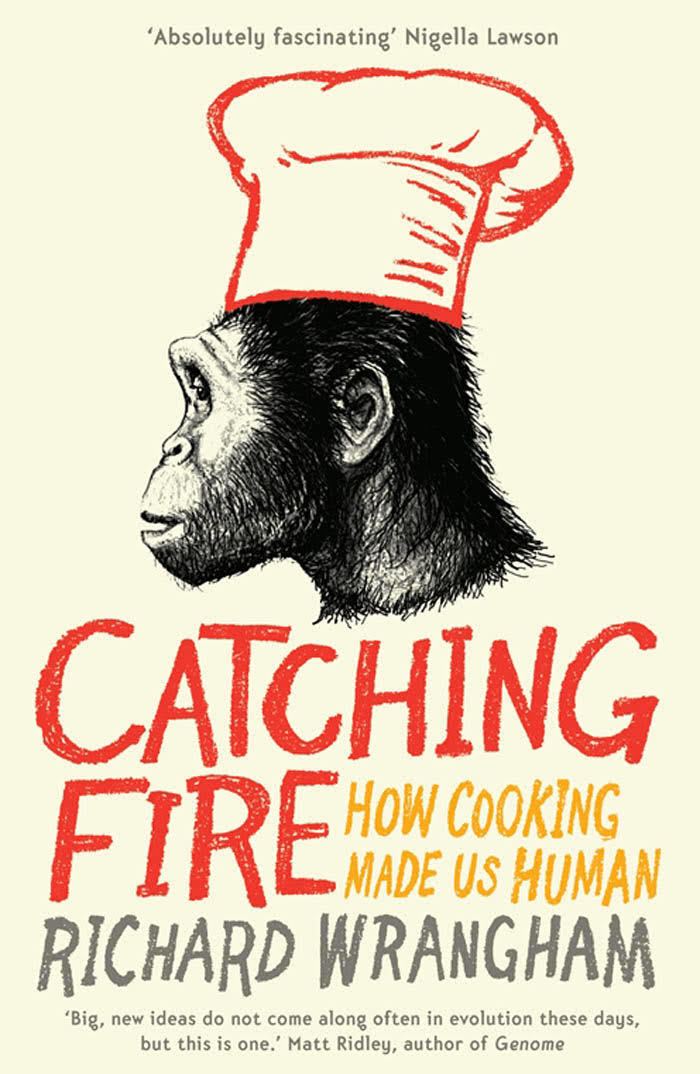
A friend recently recommended Catching Fire by Richard Wrangham. In it, he lays out a convincing thesis that cooking and food processing were instrumental to human evolution. The message boils down to humans have big brains because we have small intestines. We can have small intestines because cooked food is more efficiently digested so we get more nutrition with less internal plumbing. Like many non-fiction books, the thesis is can stated in a sentence or two, the rest is showing the work. Wrangham takes the reader through millennia of human history and all around the globe. He references modern-day raw foodists and our primate cousins, Inuit tribes and city dwellers. It is an eye-opening journey.
However the one quotation that truly stuck with me wasn’t from Wrangham. It is something that he quoted from Alfred Russel Wallace, a contemporary and scientific ally of Charles Darwin. Right in the beginning, on page 10 of Catching Fire, “man is enabled through his mental faculties ‘to keep with an unchanged body in harmony with the changing universe.'” That blew my mind because for months now I have been trying to define to myself what makes humans special compared to other animals, trying to identify that human spark.
Use of tools does not define humans, all sorts of animals use tools. Various species of primates can identify themselves in a mirror. Many mammals communicate vocally and live sociably. I eventually settled on the idea that the human spark is the ability to out evolve evolution. It sounds strange and I need to explain it each time I mention it. Wallace’s description is similar to my idea but more erudite so I am going to borrow it going forward.
Humans can not live underwater, but we do have submarines. Humans need oxygen to survive, yet we are on the cusp of a space travel revolution. No animal that did not evolve to live in Antarctica will be able to survive more than a few hours. No animal except humans. Technically Wallace’s thesis is nothing more than an extremely high level of tool use. But it is the way the tools are used that makes the difference. Humans can use tools to survive in all sorts of places inimical to our naked bodies. We do not need to live on the boundaries of new lands for millions of years while slowly evolving to the new environment.
This idea of an “unchanged body in a changing universe” also has implications for artificial intelligence. Many AI researchers are willing to say that AIs are only good for their specific tasks. An AI developed to learn and play chess is unable to run an automated warehouse. There is just no crossover and no parity with humans. Wallace’s statement in this context would be if AIs develop consciousness or create a singularity or whatever term is used. If an AI is able to make the unassisted leap from its designed role to a new role, it has moved its unchanged body though a changing universe. And that is why Wallace’s landed so well with me. It very succinctly states how humans are different from other animals and how AIs are currently different than humans.

 The Keasy Depot