Morrowind has some great writing. It contains hundreds of books, each a completely realized short story. But I want to focus on the generic dialogue available from NPCs, specifically the dialogue involving colonization and self-rule. This dialogue is used to build a convincing world showing who does and does not benefit from the current power structure. It should surprise nobody that wealthier merchants and certain races wax poetically about the Empire’s greatness and all the prosperity it has brought. Of course many, many characters espouse the opposite view that the Empire is nothing but a bunch of thieves and scum bent on exploiting the resources of Vvardenfell (the district where the game takes place). The truth like most truths is probably somewhere in the middle. The more interesting question asks if the colonized population of Vvardenfell should even be allowed to rule themselves.
The Empire is omnipresent in Morrowind. The player character generator takes the form of an interview with an imperial tax collector. Vvardenfell’s two most valuable raw materials, ebony and glass (more on those in a moment), are exported through a monopoly by the East Empire Company, an obvious nod to the East India Company. Artifacts of an ancient and extinct race of Vvardenfall natives are considered personal property of the Emperor. Through quests and dialogues the observant player is exposed to a local population which has lost control of their own resources and even their own history. In all aspects the Empire uses Vvardenfell for its own purposes and allows any local Dunmer (the current natives of Vvardenfell) self-rule a tool to prevent revolts or uprisings.
In this context it looks like the Empire is bad and one could be sympathetic towards the local Dunmer population that would simply like to be in charge of their own affairs. They want a piece of the wealth being extracted from their ground and their heritage. But a closer look at some of the NPC generic dialogue might make a player revisit that initial belief.
Morrowind is the only province in the entire Empire where slavery is still legal. Not only is it legal, it is widely supported by the colonized Dunmer. The more traditional Dunmer will militantly claim slavery is their heritage and right. The more progressive Dunmner that are more tied into the Imperial occupation are more apologetic; slavery is a necessary evil to prevent a Dunmer civil war.
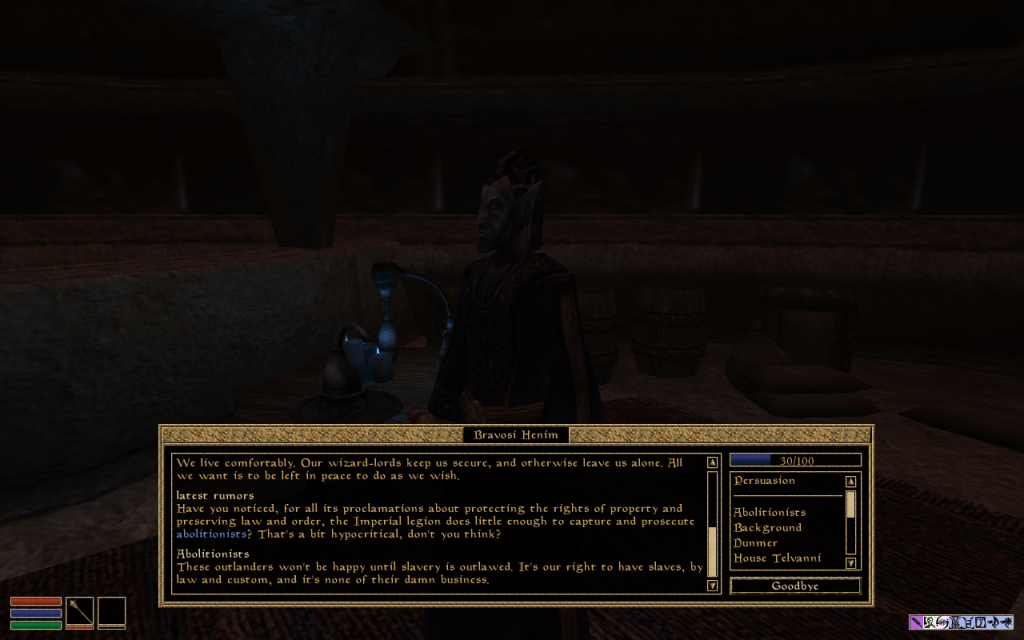
The representation of slavery further complicates the picture. The mines that produce much Vvardenfell’s wealth by producing ebony and glass are owned by outlanders. But these mines are all staffed by local Dunmer miners, not slaves. Conversely, the large Dunmner-owned plantations are worked by imported Khajiit and Argonian (cat and lizard-like people respectively) slaves. The conquering empire that is stealing Dunmeri wealth is the one trying to promote a proper and more humane economic system. Outlanders offer the locals paid employment while the local elites bring in foreign slaves.
In this confusing hybrid, the monopoly charter given to the the East Empire Company is a necessity. If the Empire wants Vvardenfell ebony and glass, but also opposes slavery, ebony and glass producers must be given special considerations to avoid being undercut by local businesses that would use slaves in the mines.
All in all, Morrowind presents a nuanced view of foreign occupation. It is unfair that the local people are unable to profit from their resource wealth or their heritage. However, the heritage they want to preserve is abhorrent and the occupiers are far more racially tolerant. In a real world where police violence is under a long-overdue microscope, a quest involving a law enforcement officer of an occupying power explicitly asking the player to commit extra-judiciary killings feels wrong. But what if those targets are violent criminals paying off the courts and espoused racists who think the only good outlander is an enslaved outlander? It makes the player think about on which side they really want to be.

 The Keasy Depot